Key Information
Construction
13–15th century
Castle Type
other
Current Status
Intact
Gallery
Historical Overview
Overview
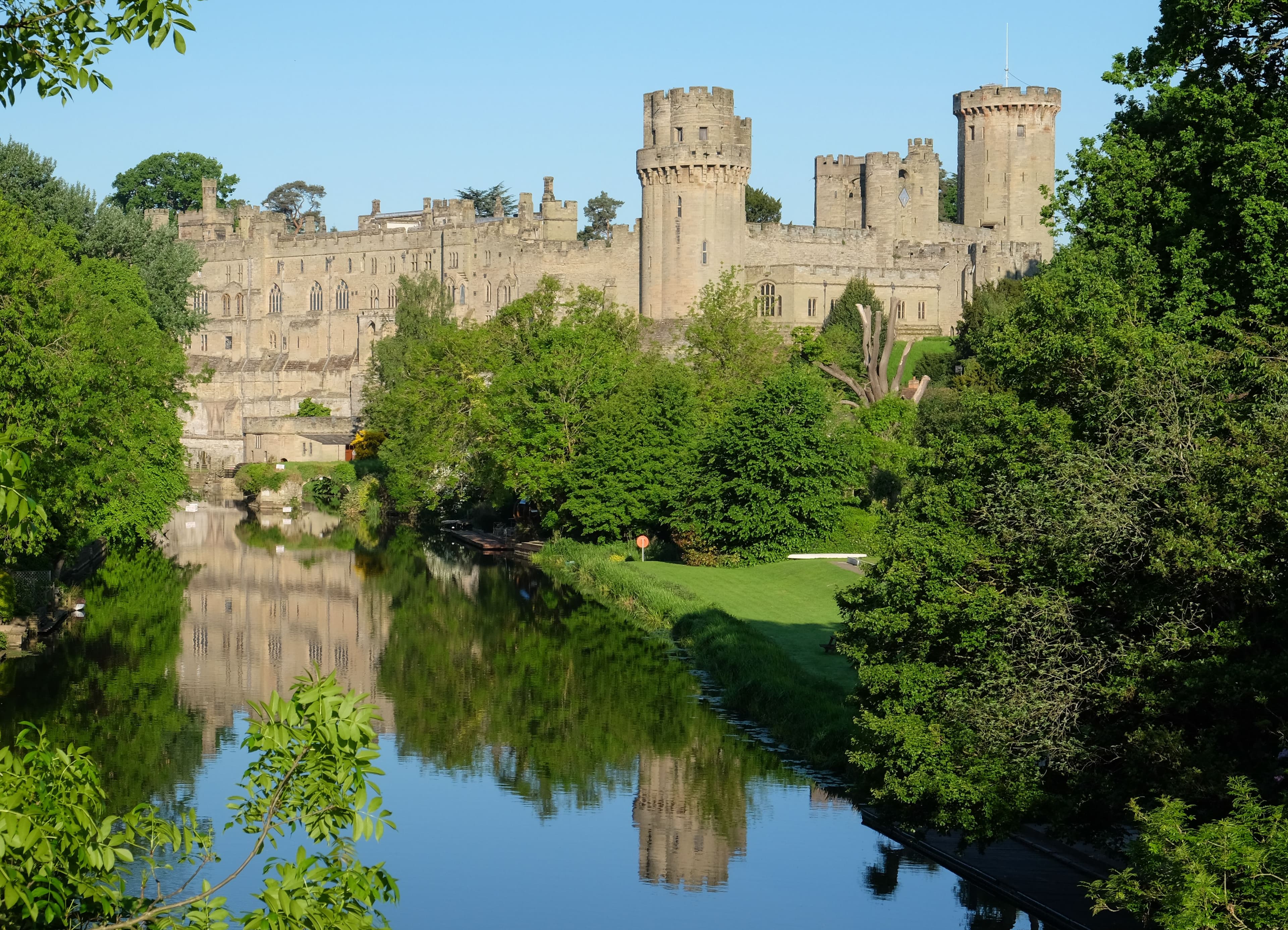
Warwick Castle is one of the most complete and celebrated medieval castles in England, standing majestically on the banks of the River Avon in Warwickshire. Originally founded by William the Conqueror in 1068 as a Norman motte-and-bailey fort, it evolved over the centuries into a powerful stone fortress and later into a grand aristocratic residence. The castle has witnessed nearly a thousand years of English history — from feudal warfare to royal intrigue and Victorian splendour — and remains one of the best-preserved examples of a great medieval stronghold in Britain. Today it is managed by Merlin Entertainments and open to the public as a major heritage attraction.
Early history
The original castle was one of a chain of fortifications established by the Normans to secure their conquest of England. Built on a natural bluff overlooking a bend in the Avon, its strategic position controlled access to the Midlands. The first timber fortification was soon replaced in stone during the 12th century by the Beaumont earls of Warwick. Throughout the Middle Ages, Warwick Castle played a central role in both local governance and national politics, especially under the powerful Beauchamp family, who transformed it into one of the most formidable fortresses in England.
Building and layout
The castle’s core follows the traditional motte-and-bailey design, though greatly expanded and strengthened in stone over time. The massive curtain walls enclose a large inner bailey with two great gatehouses, Caesar’s Tower (dating from the 14th century) on the east, and Guy’s Tower on the south-west, both soaring over 30 metres high. Within the enclosure stand the great hall, domestic ranges, and private apartments, which were remodelled during the Tudor and Stuart periods. The castle’s defences once included a barbican, drawbridge, and deep dry moat carved into solid rock.
Later history and transformation
In the late medieval period, Warwick Castle became the seat of the Neville family, most notably Richard Neville, the “Kingmaker”, whose political manoeuvring during the Wars of the Roses made him one of the most powerful figures in 15th-century England. Following the decline of the Nevilles, the castle passed to the Dudley family, later Earls of Warwick, who converted the fortress into a stately home. Extensive alterations in the 17th and 18th centuries softened its martial character — the interiors were redesigned in the grand country-house style, gardens and terraces were laid out, and the rooms were furnished with art and antiquities collected during the Grand Tour.
During the Victorian era, Warwick became a symbol of noble heritage and chivalric romance, hosting royal visitors and society gatherings. Its well-preserved medieval defences, combined with its lavish interiors, made it one of the most admired castles in England.
Present condition
Today, Warwick Castle is a Grade I listed building and Scheduled Monument, renowned for its exceptional preservation and historical depth. The site includes the medieval fortifications, great hall, state rooms, dungeons, and landscaped gardens designed by Capability Brown in the 18th century. Visitors can explore towers, ramparts, and exhibitions that interpret both the castle’s medieval warfare and its later aristocratic life. Despite its adaptation for tourism, the fabric of Warwick Castle remains remarkably intact, offering one of the most vivid and tangible experiences of English castle life from the Norman Conquest to the modern age.
Help Improve This Page
Help to document and preserve British castle heritage for future generations.
Share your photographs
Write and review content
Support the project