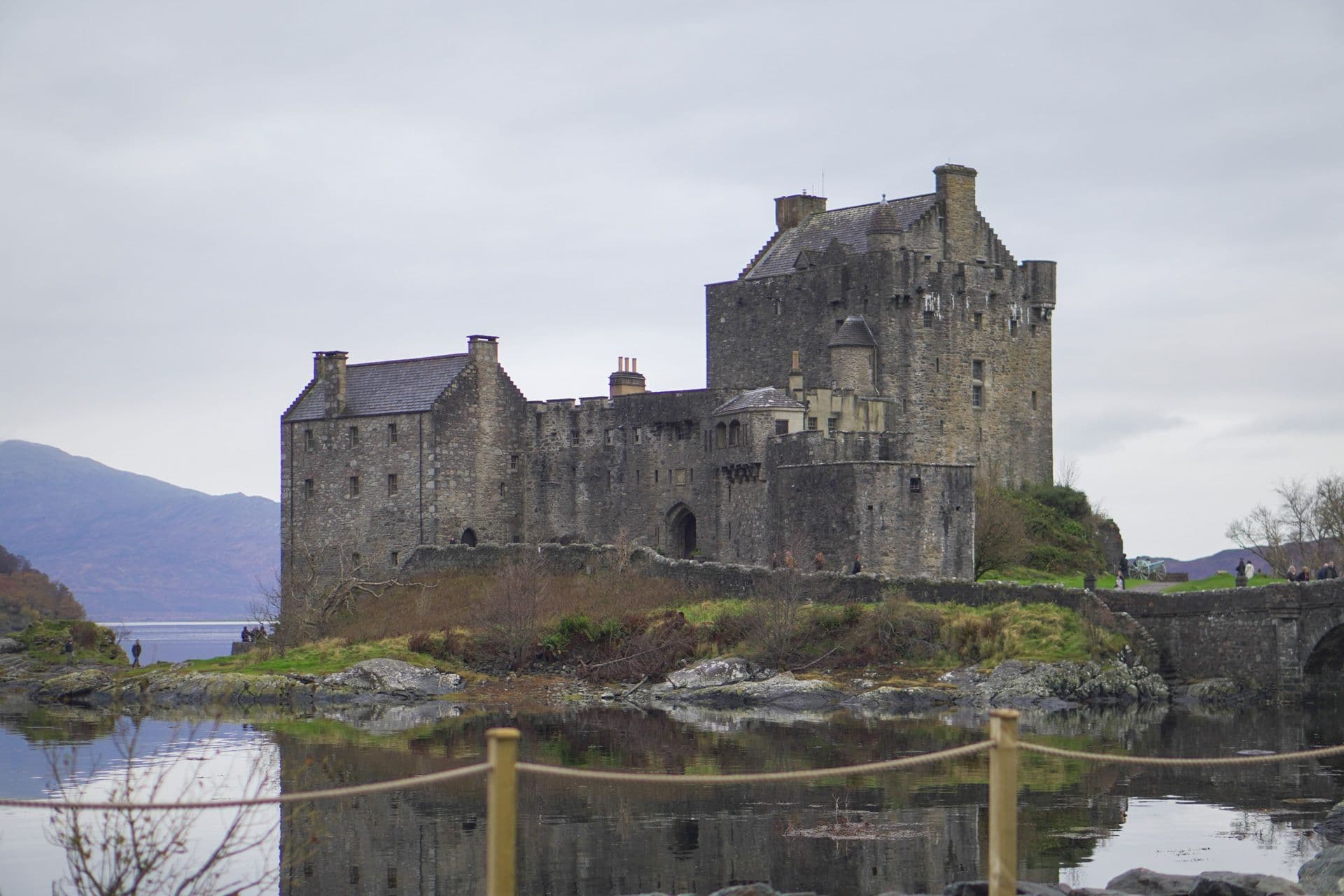
Eilean Donan Castle

Eilean Donan Castle

Highland
Scotland

Key Information

Construction

Castle Type

Current Status

Historic monument

Historical Overview

Overview

Eilean Donan Castle is one of Scotland’s most iconic and picturesque fortresses, dramatically situated on a small tidal island at the meeting point of three sea lochs — Loch Duich, Loch Long, and Loch Alsh — near Dornie in the western Highlands. Originally founded in the early 13th century, it served as a stronghold of the Mackenzie and later the MacRae clans. Though destroyed in the 18th century and left in ruins for nearly 200 years, the castle was painstakingly rebuilt in the early 20th century, becoming a symbol of Scottish heritage, resilience, and romance.

Early history

Eilean Donan’s strategic location made it a natural defensive site, controlling access to the western sea routes and serving as an outpost against Norse incursions. The first stone fortification was probably established around 1220 by Alexander II as part of his campaign to consolidate royal authority in the west following the defeat of the Vikings.

By the 14th century, the castle had become a stronghold of the Mackenzies of Kintail, one of the most powerful Highland clans. It served both as a defensive bastion and a symbol of Mackenzie influence, guarding their extensive territories across Wester Ross. The Mackenzies later entrusted the castle to their loyal allies, the MacRaes, who acted as hereditary constables of Eilean Donan for centuries.

Building and layout

The medieval castle evolved through several phases, beginning as a simple rectangular keep and expanding over time into a complex of curtain walls, towers, and domestic ranges that covered much of the island. The later medieval structure included a central tower house, courtyard, and sea gate, all surrounded by sheer rock rising from the loch waters. Its design reflected both the natural strength of its position and the changing needs of Highland warfare.

The castle’s isolation — accessible only by boat or, at low tide, across a narrow causeway — added to its defensive power.

Later history and destruction

During the Jacobite risings of the early 18th century, Eilean Donan became embroiled in rebellion. In 1719, a force of Spanish troops supporting the Jacobite cause occupied the castle and stored gunpowder there. A British naval squadron attacked, bombarding the fortress for three days before landing and blowing it up with explosives. The castle was left in complete ruin, its shattered walls abandoned to the elements for nearly two centuries.

Restoration and revival

In 1911, Lt. Colonel John MacRae-Gilstrap, a descendant of the castle’s original constables, purchased the island and began an ambitious 20-year reconstruction project. Working with architect George Mackie Watson, he based the design on surviving ruins, early drawings, and local tradition. The restoration, completed in 1932, recreated the romantic medieval form of the castle while incorporating modern comforts.

The rebuilt Eilean Donan included a stone bridge linking the island to the mainland — a feature that has since become one of Scotland’s most recognisable landmarks.

Present condition

Today, Eilean Donan Castle stands fully restored, open to the public, and maintained by the Conchra Charitable Trust. Its interior includes period rooms, clan artefacts, and exhibits on the Mackenzie and MacRae histories. Surrounded by mountain scenery and reflected in the still waters of the loch, the castle is one of the most photographed sites in Scotland, frequently appearing in films, television, and literature.

A Category A listed building and Scheduled Monument, Eilean Donan is more than a reconstruction — it is a national symbol, embodying Scotland’s enduring connection between land, clan, and legend.

Advertisement

Help Improve This Page

Help to document and preserve British castle heritage for future generations.

Share your photographs

Write and review content

Support the project

Learn more